

How preservation, scope, custodians, and protocol decisions shape cost and defensibility before documents reach review.
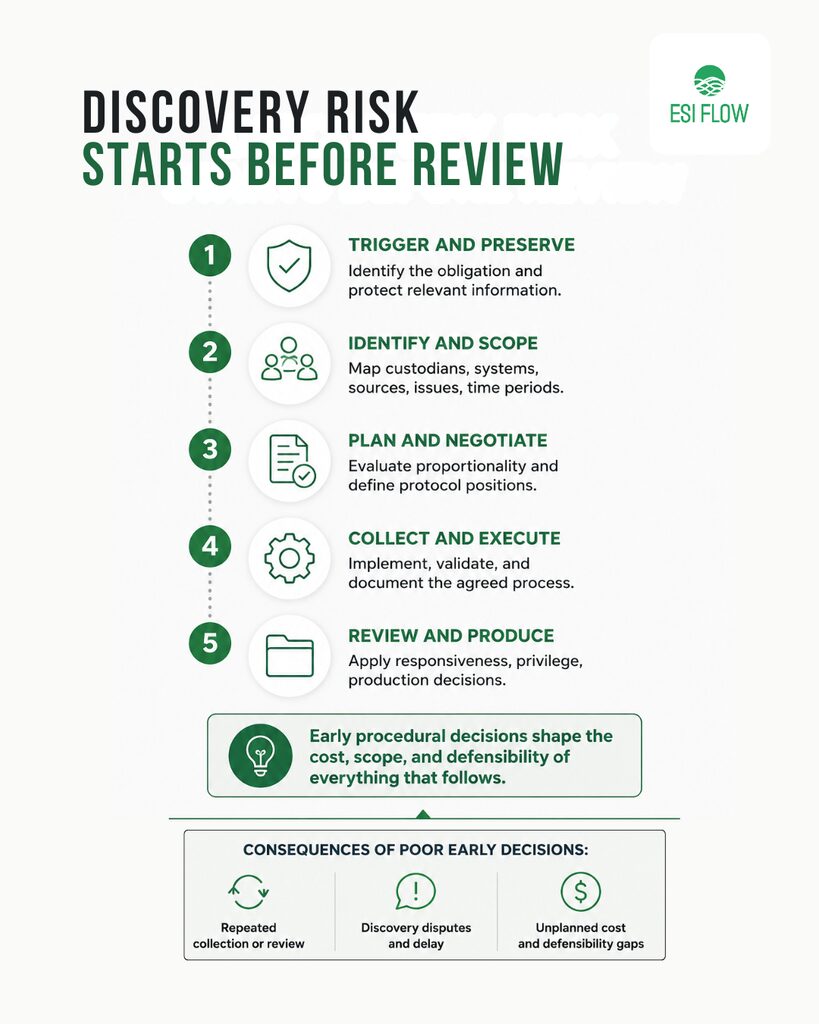
Discovery risk starts before documents reach a review platform. Decisions about preservation, custodians, data sources, scope, proportionality, search methodology, and production can shape the cost and defensibility of discovery long before a reviewer makes the first responsiveness or privilege determination.
These decisions are often made quickly and across several participants: in-house counsel, outside counsel, litigation support and IT teams, service providers, clients, and opposing parties. When the reasoning behind them is incomplete, uninformed, inconsistent, or poorly documented, the consequences can emerge later as expanded collections, repeated searches, avoidable disputes, difficult data, budget overruns, or challenges to the defensibility of the process.
Review remains an important source of discovery risk. But review operates inside boundaries established earlier. Managing discovery well therefore requires more than improving the review process. It requires a structured way to identify, evaluate, negotiate, document, and implement the procedural and technical decisions that determine what collection and review will eventually contain.
The Misconception About Discovery Risk
Ask most litigation teams where discovery risk lives, and they’ll point to review: responsiveness calls, privilege determinations, and the judgment-heavy work that happens once documents are in a platform. Those risks are real, but they are only part of the discovery lifecycle.
Review risk is often downstream from earlier choices. Before review begins, the team may already have decided which people and systems are in scope, what information must be preserved, how data will be collected, what search or culling methods will be used, which production formats will apply, and how disputes will be escalated. As a result, terms that may appear simple from a legal drafting perspective can create substantial technical complexity when translated into the workflows, configurations, and quality controls required to conduct the review.
Where Discovery Risk Actually Begins
Risk can begin when litigation is reasonably anticipated and the duty to preserve potentially relevant information is triggered. From there, the team must translate a legal obligation into operational decisions: who may possess relevant information, which systems and data sources should be considered, what time periods and issues are in scope, and how the preservation process will be implemented and documented. A legal hold is one part of that process, not necessarily its starting point.
Risk continues through collection scoping, when a key custodian or data source may be left off a list because nobody thought to ask the right question early enough. It continues further with scope, when “reasonable” gets defined under time pressure instead of through structured analysis.
These decisions may be treated as administrative steps even though they require legal, factual, technical, and operational judgment.
Why ESI Protocols Matter
An ESI protocol converts many early discovery decisions into agreed operating rules. Depending on the matter, it may address preservation issues, production format, metadata, search methodology, technology-assisted review, privilege procedures, inaccessible sources, phased discovery, and the process for resolving disagreements.
The protocol does not eliminate every dispute, and it does not replace the team’s broader discovery plan. Its value lies in making material assumptions, responsibilities, and procedures visible before the parties begin executing against them. Ambiguity at this stage can become expensive later, especially if the parties discover that they interpreted the same provision differently after collection or review has begun.
In our next article, we will examine the ESI protocol as the operating system of discovery: the document that connects procedural decisions to day-to-day execution.
How Procedural Decisions Compound
None of these choices happen in isolation. A narrow custodian list compounds into a narrower search. A rushed proportionality argument compounds into a scope fight six months later. A protocol negotiated without input from the people who’ll execute it compounds into rework that shows up as an unplanned cost on someone’s budget.
A Common Compounding Sequence
A team begins with an incomplete understanding of the client’s data environment. That leads to a custodian and source list that omits a collaboration platform. Search terms and collection estimates are then developed using the incomplete population. The missing source is identified after review begins, requiring supplemental preservation, collection, processing, review, and production. What appeared to be a small scoping decision becomes repeated work across the discovery process.
This is what makes early-stage discovery decisions so easy to underweight and so expensive to ignore: the cost of a bad procedural call rarely shows up where the call was made. It shows up two or three steps downstream, disguised as a review backlog, a blown budget, or a motion to compel, by which point it’s much harder to trace back to the decision that actually caused it.
What Modern Litigation Teams Should Do Differently
Modern litigation teams should treat early discovery decisions as a defined decision process rather than a series of disconnected tasks. At a minimum, the team should be able to answer five questions:
1. What triggered the preservation obligation, and how was that determination documented?
2. Which people, systems, data types, and time periods may contain relevant information?
3. What assumptions support the proposed scope, and how does proportionality affect it?
4. Which issues must be negotiated or documented in the ESI protocol?
5. Who is responsible for implementing each decision, validating execution, and escalating changes?
The goal is not to eliminate judgment. Discovery is too matter-specific for that. The goal is to make judgment more consistent, visible, explainable, and operational.
That is the missing layer between procedural authority and discovery execution. Court rules, standing orders, prior protocols, matter facts, and professional experience all inform the decision. Modern teams need a structured way to bring those sources together before early choices become downstream cost and risk.
Discovery risk starts before review. The opportunity to manage it should start there too.
ESI Flow is building procedural intelligence for discovery teams, helping them evaluate and operationalize ESI protocol decisions before review begins.
Sources and Further Reading
• Federal Rule of Civil Procedure 26(b)(1) – Addresses proportional discovery and the scope of discoverable information. https://www.law.cornell.edu/rules/frcp/rule_26
• Federal Rule of Civil Procedure 26(f) – Addresses parties’ obligations regarding preservation and disclosure or discovery of electronically stored information. https://www.law.cornell.edu/rules/frcp/rule_26
• Federal Rule of Civil Procedure 37(e) – Addresses failure to preserve electronically stored information and sanctions. https://www.law.cornell.edu/rules/frcp/rule_37
• The Sedona Conference Publications – Guidance on legal holds, proportionality, and cooperation in discovery. https://www.thesedonaconference.org/publications