
Litigation is finally catching up to the rest of the modern enterprise. Product teams work in components. Marketing teams work in templates. Engineering teams work in reusable modules. Yet litigation, especially discovery, still operates like every matter is a bespoke art project. As a result, teams face inconsistent drafting, avoidable disputes, and expensive reinvention. The Stanford article I recently co-authored with Adam Rouse, Tamra Moore, Renee Meisel, and Olga Mack, From Cost Center to Command Center: The Future of Litigation is Being Built In-House, makes this clear by showing that in-house teams are already moving toward modular, data-driven litigation systems.
If litigation is becoming modular, your ESI protocols must evolve with it. The structure of your clauses, the logic inside your playbooks, and the intelligence behind your decisions all need to be modular enough to reuse, adapt, and audit across matters. Modularity is not a design choice. Instead, it is how you reduce disputes, accelerate drafting, and maintain consistency across outside counsel and jurisdictions. That is the future clients expect and the only way to build a litigation system that scales.
How Modular Litigation Already Transformed Contracts and Software
In other fields, modularity is no longer new. Software engineering uses components that teams can assemble into full systems. Contracting has moved from full document drafting to clause libraries and cross-functional templates. Knowledge management systems rely on tagged, reusable elements rather than long narrative PDFs. Because of that, modularity creates speed, reduces inconsistency, and makes it possible to update one component without breaking everything else.
George Triantis documented this more than a decade ago in his work on modular contracting. His insight was simple and timeless: modular systems reduce complexity and improve quality. They create building blocks that teams can use again and again, each with defined behavior and predictable outcomes.
Now litigation is entering the same era. In-house teams want structured components. They want clause-level intelligence. They want jurisdiction-aware guidance. They want playbooks that do not just describe preferences but operationalize them. In other words, modularity is the foundation for all of this.
Why Discovery Still Resists Modular Litigation
Discovery work has resisted modularity for years because teams mistake variation for uniqueness. They assume that because every matter has its own facts, every protocol must be built from scratch. That assumption is wrong. Matters differ, but systems do not. Burden drivers do not. Messaging platforms do not. Metadata constraints do not. Privilege log patterns do not. Jurisdictional tendencies do not.
The variability in discovery comes from facts. The structure of discovery comes from systems. Most clauses in an ESI protocol repeat the same logic, the same pitfalls, the same feasibility limits, and the same negotiation dynamics. Even so, teams rebuild those clauses each time. They rewrite language manually. They rely on old drafts with inconsistent edits. They cut and paste obligations that do not match the current matter. That approach is inefficient, error-prone, and costly for clients.
Discovery is not bespoke. It is modular work. You just need the system to support it.
Why Modular ESI Protocols Start With Clauses, Not Documents
The unit of work in modern discovery is not the protocol. It is the clause. A clause can be tagged, versioned, interpreted, logged, and improved. It can carry data about feasibility, burden, fallback options, system requirements, and jurisdiction preferences. It can also be reused across matters while still being tailored to specific facts.
Documents cannot do any of this. They hide decision logic. They blend risk categories. They bury the rationale behind edits. They make it almost impossible to audit behavior across cases. Once you move from documents to clauses, you gain visibility. You can see where disputes arise, which clauses cause trouble, which ones reduce motion practice, which ones courts favor, and which ones need retirement.
Clause-level intelligence is the real shift behind modular litigation.
How Agentic Playbooks Strengthen Modular Litigation Strategy
The Stanford article points to a major transition taking place inside legal departments: playbooks are no longer static PDFs. They are becoming agentic systems. That means they encode decision pathways, fallback positions, and logic chains. They can respond, not only inform. They can surface the right clause at the right moment. They can alert you when a request violates internal standards. They can also align outside counsel across matters without endless email reminders.
Agentic playbooks turn preference into operational strategy. They make your view of metadata, your definition of scope, your tolerance for messaging platform obligations, and your privilege log philosophy part of the system rather than part of institutional memory.
This is how modern litigation teams scale their thinking. That is also why modularity matters. Playbooks cannot become agentic unless the building blocks inside them are structured, tagged, and reusable.
The ESI Flow Blueprint for Modular Discovery
Modularity at scale requires a platform that understands the anatomy of discovery. ESI Flow is built for this shift. It connects clause libraries, jurisdiction layers, system behavior profiles, drafting guardrails, and fallback logic into a single structured workflow. As a result, it ensures that the components you use stay consistent, grounded, and technically feasible.
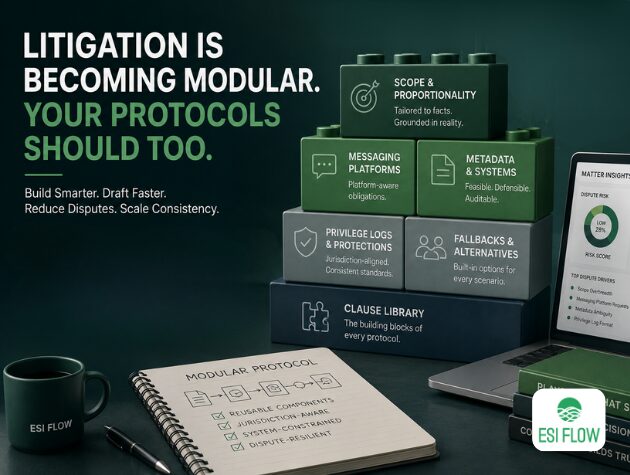
Modular drafting means you pull in components, not documents. It means you can tailor scope based on actual system behavior. It means metadata lists come pre-validated. It means privilege logs reflect jurisdiction expectations. It means messaging clauses align with platform constraints. And it means your fallback logic is embedded directly into the drafting process.
Modularity comes alive when the system knows what each clause is, what it does, where it fails, and how it should be used. That is the architecture ESI Flow provides.
How Modular Litigation Reduces Discovery Disputes
The hidden benefit of modular discovery is not speed. It is stability. When teams build protocols from vetted components, disputes drop. When clauses reflect jurisdiction norms, motion practice declines. When teams embed fallback logic instead of improvising it, negotiation moves faster. When teams tailor metadata lists instead of copying them, reprocessing events decrease. And when teams tie scope to system constraints, proportionality arguments carry more weight.
Modularity reduces risk because it reduces variation. It reduces waste because it eliminates reinvention. It reduces conflict because it aligns the protocol with reality.
This is the future of discovery. It is measurable, predictable, and intentional. And it begins with clauses, not documents.
Litigation is becoming modular. The only question is whether your protocols are keeping up.