
In-house litigation teams are no longer passengers in the litigation process. Instead, they are the operators, architects, and increasingly the decision makers who shape strategy long before a complaint is filed. The Stanford article I recently co-authored, From Cost Center to Command Center: The Future of Litigation is Being Built In-House, co-authored with Adam Rouse, Tamra Moore, Renee Meisel, and Olga Mack, traces this shift through interviews with legal leaders who are redesigning how litigation runs inside their organizations.
The message is clear. Litigation is not simply moving in-house. Rather, it is becoming orchestrated in-house. And the teams that thrive in 2026 and beyond will not be the ones who draft faster or negotiate harder. Instead, they will be the ones who build operating systems that centralize intelligence, structure judgment, and guide outside counsel through repeatable, defensible workflows. In other words, the future is orchestration, not reaction. As a result, the difference shows up in cost, clarity, and credibility.
Why In-House Is Now the Strategic Center of Litigation
This shift to in-house leadership is not philosophical. Instead, it is structural. Corporate litigation now depends on knowledge that only in-house teams possess. For example, they understand the systems that create the data. They understand the operational realities behind retention gaps, collaboration platforms, version sprawl, and messaging volume. They know the historical patterns of disputes. They know which clauses have succeeded in past matters and which ones have caused unnecessary burden. Just as importantly, they control the internal playbooks that anchor risk tolerance and negotiation boundaries.
For decades, law firms owned this work because they owned the drafting muscle. However, AI and modern drafting engines have changed that balance. When in-house teams can generate structured, jurisdiction-aware drafts in minutes, the center of gravity shifts. Consequently, what firms once delivered as expertise becomes a refinement layer instead of the foundation. The strategic layer now sits inside the company, which means the litigation command center sits there too.
Outside Counsel Needs Leadership, Not Loose Instructions
In-house leaders consistently shared this theme during our Stanford research interviews: outside counsel do not need encouragement. Rather, they need orchestration. Without clear guidance, firms default to their own templates, stylistic preferences, and risk philosophies. Consequently, this leads to inconsistent drafting, inefficient negotiations, and unpredictable spend. It also undermines the business goals of the client, who now expects consistency across matters and firms.
A litigation command center solves this by replacing loose instructions with structured logic. For instance, instead of saying “narrow scope,” the system provides the exact clause, the fallback tiers, the burden rationale, and the historical outcomes. Likewise, instead of asking firms to “consider messaging issues,” the system provides the platform profile, the feasibility notes, and the jurisdiction guidance. Rather than relying on memory, the system uses data.
Outside counsel perform best when the client sets the architecture. In that sense, a litigation command center gives them the map.
Your Judgment Is Valuable. Structure It or Lose It.
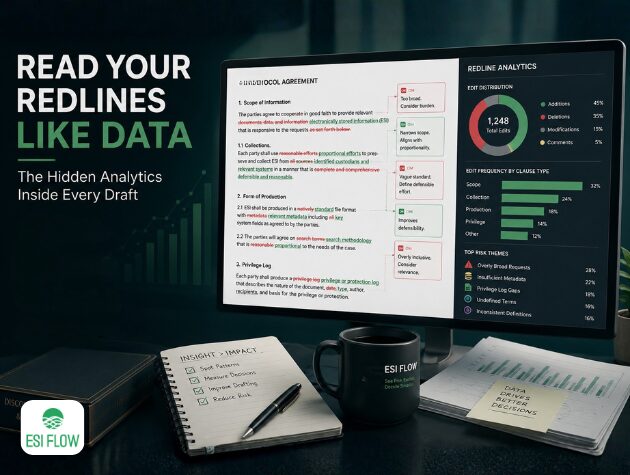
The biggest waste in litigation today is unstructured judgment. Specifically, in-house attorneys solve the same problems repeatedly because the reasoning behind good decisions is never captured. They know why a metadata field should be removed. They know why a privilege log format should be narrowed. They know which fallback positions are defensible. They know where past matters struggled in front of the court. Yet that knowledge often lives in email threads, redlines, and individual memories.
A litigation command center treats judgment as a resource, not a byproduct. It captures the reasoning inside structured fields. It logs the decision path. It classifies the risk category. It ties the choice to the system behavior and jurisdictional pattern that shaped it. Once stored, that judgment becomes reusable across matters, repeatable across attorneys, and reviewable across time.
Structured judgment is the core currency of modern litigation. In other words, it is how teams become stronger with each case instead of starting from scratch.
Litigation Intelligence Is Not Documents. It Is Patterns.
Documents tell you what happened. By contrast, patterns tell you why it will happen again. A command center thrives on patterns. For example, it aggregates clause-level dispute histories. It maps which metadata fields repeatedly break exports. It tracks which jurisdictions consistently broaden scope. It records fallback positions that regularly resolve negotiations. It logs timing patterns across drafting cycles. It also exposes where supplemental productions arise and why.
Once you see these patterns, litigation stops being episodic. Instead, it becomes operational. You can anticipate risk. You can plan budgets with confidence. You can design drafting that aligns with technical realities. You can shape negotiation narratives that reflect the court’s expectations. Better still, you can avoid unnecessary disputes because you know where they typically emerge.
Patterns are the foundation of litigation intelligence. After all, documents are only one layer of the story.
The Case for a Litigation Operating System
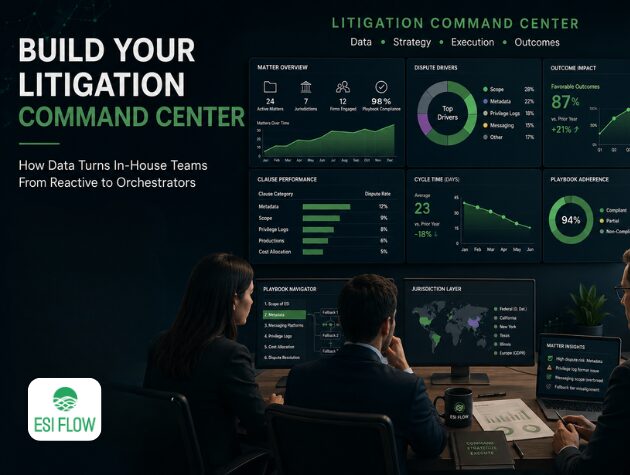
If in-house teams are becoming command centers, they need more than a clause library. Instead, they need an operating system for litigation. A true litigation command center unifies:
Clause intelligence
Jurisdiction preferences
System behavior profiles
Decision frameworks
Fallback logic
Cost insights
Historical outcomes
Outside counsel performance
This is not a set of PDFs. Instead, it is a structured, dynamic, continuously improving intelligence layer that connects drafting, negotiation, and post-matter analysis. It allows teams to make decisions with clarity and defend those decisions with evidence. As a result, it turns litigation from a series of tactics into a strategic, data-driven function.
An operating system is how in-house teams move from reactive firefighting to proactive orchestration.
How ESI Flow Becomes the Command Center Layer
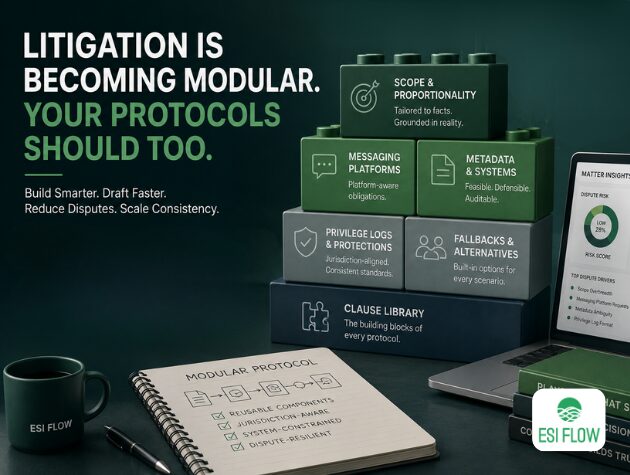
ESI Flow is designed to sit at the center of this transformation. It provides the structure litigation work has been missing. It turns judgment into data. It captures clause categories, feasibility notes, fallback paths, and jurisdiction signals. It embeds guardrails that prevent drafting drift. In addition, it connects intake, drafting, negotiation, and outcome tracking into a single knowledge system. It supports the modularity and agentic playbooks described in the Stanford article and makes them operational instead of theoretical.
Most importantly, ESI Flow turns in-house preferences into strategy. It lets teams generate the first draft with confidence. It anchors burden narratives in technical reality. It standardizes playbook logic across matters and outside counsel. As a result, it reduces variance. It reinforces discipline. It builds institutional memory. Ultimately, it transforms discovery from unstructured work into orchestrated intelligence.
This is what a litigation command center does. It aligns players, processes, and patterns so that litigation becomes controlled instead of chaotic.
The future of litigation will not be defined by who argues best in court. Instead, it will be defined by who orchestrates best before the courtroom is ever involved. The power is shifting in-house. And so, the teams who build their command centers now will define the next decade of litigation practice.