

An in-house litigation system is no longer a future concept. Instead, it is becoming the foundation of how modern legal departments will manage disputes in the next decade. That shift is already underway, and it is documented clearly in the Stanford Law article From Cost Center to Command Center: The Future of Litigation is Being Built In-House co-authored with Adam Rouse, Tamra Moore, Renee Meisel, and Olga Mack.
The article describes a transformation driven by modular workflows, structured playbooks, data-informed decisions, and agentic systems that turn litigation from a reactive service into a coordinated function. It also makes something else clear. Law firms will not build this system for you. They cannot. After all, the incentives, the visibility, and the ownership all sit with the enterprise. So if in-house counsel want consistency, intelligence, and leverage, they must build the system themselves. In other words, the future of litigation belongs to teams that orchestrate, not delegate.
Why Outside Counsel Cannot Own Your In-House Litigation System
Law firms deliver expertise, advocacy, and judgment. However, they do not deliver infrastructure. They are not designed to build systems that last longer than the matter they are handling. For example, they cannot maintain clause libraries that reflect your systems, your risk tolerance, your data environment, your history of disputes, or your long term strategy. Nor can they normalize decisions across matters or across firms. Likewise, they cannot track your internal retention settings or system behavior across business units.
Their lens is the case. By contrast, your lens is the enterprise.
If you rely on law firms to build your architecture, you end up with inconsistent drafts, fragmented knowledge, and a litigation operation that looks different depending on who your outside counsel is. As a result, that model does not scale. It does not reduce cost variation. It does not strengthen institutional memory. Most importantly, it does not give you the control you need to protect the business.
Owning the architecture is not optional. Rather, it is strategic.
Modularity Requires Memory Inside the In-House Litigation System
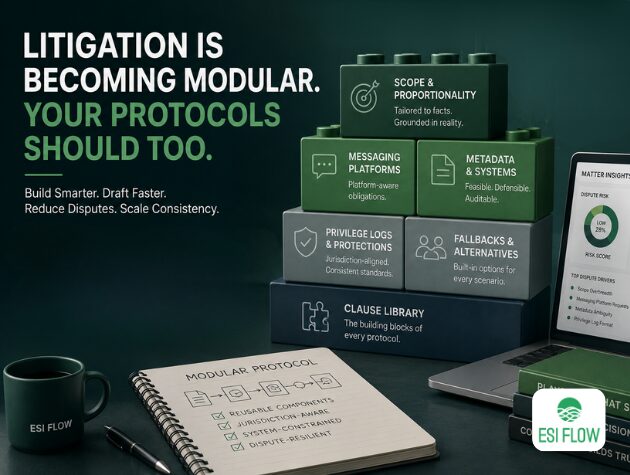
The Stanford piece highlights a fundamental shift. Litigation is becoming modular. Matter types, jurisdictions, risk profiles, and data environments all point toward repeatable components rather than bespoke reinvention. For example, in-house teams want jurisdiction-specific clauses. They want templates that reflect their systems. They want fallback structures that preserve leverage. In addition, they want clause-level decisions that evolve with use.
Yet you cannot outsource modularity because modularity requires memory. It requires knowing what worked, what failed, what caused disputes, what increased burden, and what saved the client money. In practice, law firms do not see enough of your matters across time to build this memory. Even when they try, that knowledge stays with the partner or the associate, not the enterprise.
ESI Flow gives you the structure to turn modularity into an operating model. Your clauses. Your templates. Your system intelligence. Your history. As a result, nothing leaves the organization.
Analytics Only Matter When the In-House Litigation System Owns the Data
Analytics is another theme emerging from the Stanford research. But analytics only works when you control the inputs. Outside counsel can tell you what happened in a particular matter. However, they cannot give you cross-matter intelligence. They cannot map clause patterns across four years of disputes. They cannot analyze how your data systems behaved across dozens of cases. Nor can they compare cost curves between similar matters.
Analytics requires:
Your dispute history
Your protocol edits
Your system constraints
Your jurisdiction patterns
Your fallback success rates
Your volume profiles
Law firms do not have this. They never will. They only see a slice. Therefore, if you want analytics that reveal predictable cost drivers, negotiation patterns, and drafting risks, you must own the data stack. In turn, ESI Flow becomes the structure that turns this scattered information into a single intelligence layer.
Data Governance Must Be Built Into the In-House Litigation System
Data governance is not a litigation decision. Instead, it is a corporate governance decision. It touches retention, privacy, system behavior, access control, and technical feasibility. Outside counsel cannot assess your data hygiene. They cannot fix your retention inconsistencies. They cannot see how Slack channels grow without management. In addition, they cannot map merger legacy systems or shared drive sprawl.
They see the evidence only when it becomes a problem. Meanwhile, you see it before it ever appears in a matter.
A litigation system that ignores data governance will always overpromise and underdeliver. By contrast, a system that integrates governance at the drafting stage protects the company. Accordingly, ESI Flow’s structured intake and system-aware workflows bridge the gap between legal strategy and operational reality.
Clause Libraries Should Match Enterprise Reality, Not Firm Preference
Clause libraries inside firms reflect firm experience, not enterprise needs. They are shaped by the matters the firm has handled, the partners who built them, and the jurisdictions the firm sees most often. As a result, they do not reflect your systems, your retention risks, your organizational preferences, or your long-term strategy.
If you rely on a firm’s clause library, you draft according to their worldview. That means you outsource your leverage. You also lose visibility into why decisions were made or how clauses evolved.
When you build your own clause library, something different happens. Your drafting becomes consistent across firms. Your risk posture becomes stable. Your fallback logic becomes predictable. In turn, your proportionality arguments become stronger. At the same time, your burden narratives become grounded in evidence.
ESI Flow is designed to hold the clause library inside the enterprise, not inside the firm.
Agentic Playbooks Strengthen the In-House Litigation System
The Stanford article describes a trend that is accelerating fast. Playbooks are evolving into agentic systems that do more than store information. They also execute logic, recommend decisions, and enforce rules. These systems cannot be owned by outside counsel because they encode enterprise strategy. Specifically, they include business risk preferences. They include internal constraints. They include jurisdiction choices, system limits, fallback logic, and dispute history.
If you give this power to a law firm, you fragment your strategy across different partners, offices, and billable models. On the other hand, if you own the logic, you create internal alignment across every matter and every firm working on your behalf.
ESI Flow acts as the agentic layer that operationalizes your preferences and protects your judgment. As a result, what you encode becomes the standard, no matter who drafts the document.
Build the In-House Litigation System as a Command Center
The Stanford piece makes one thing unmistakable. Litigation is shifting from firm-led to client-orchestrated. Accordingly, in-house teams are becoming command centers. That role requires structure, data, intelligence, and tools that live inside the enterprise.
A command center needs:
Your templates
Your playbooks
Your clause logic
Your jurisdiction knowledge
Your dispute histories
Your system intelligence
Your fallback outcomes
Your data governance patterns
Law firms contribute expertise. Meanwhile, in-house teams orchestrate the system. As a result, ESI Flow becomes the engine that powers that orchestration by turning your knowledge into a structured, reusable, and defensible operating model.
In-House Must Build What Outside Counsel Cannot
The future of litigation belongs to teams that own their architecture. It belongs to in-house departments that see litigation as a coordinated function rather than a series of disconnected cases. More importantly, it belongs to legal leaders who understand that you cannot outsource your intelligence, your leverage, or your structure.
Outside counsel will always be essential. However, they will never build your system. That responsibility sits with you. And if you build it well, you transform litigation from a cost center into a command center.
This is the future described in the Stanford article. It is already here. Now, ESI Flow is how you operationalize it.